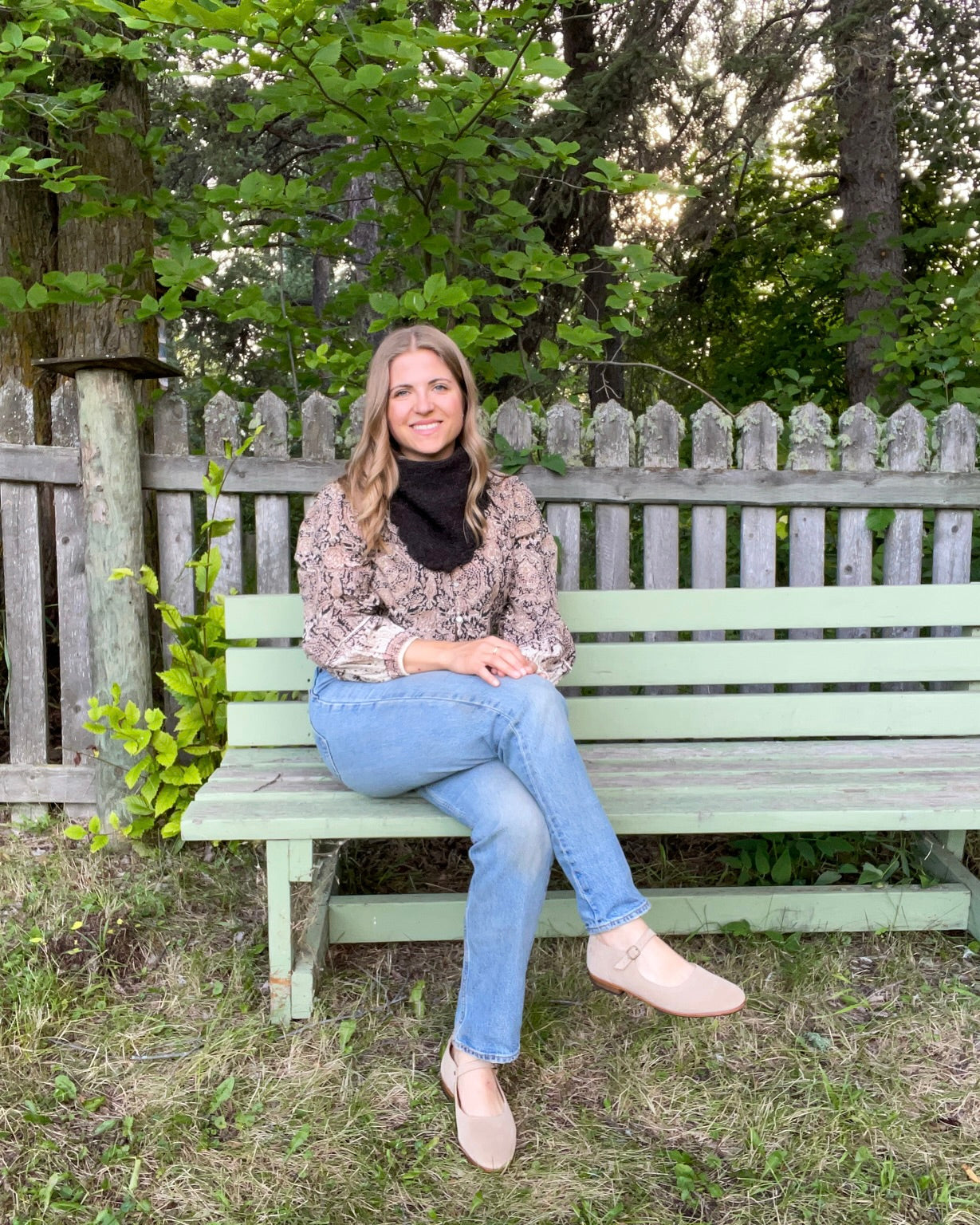
Emma @emmaruthpalm & Isis @tenderlivingfarm
I met Emma through social media, and after a long-running conversation in our DMs, I felt a little like I already knew her. Then, while vending at Market Collective's holiday market last winter, I walked up to Isis and started chatting with her as though we had met before. Her face had appeared so often in Emma's photographs that I had simply assumed she was Emma.

I soon learned that Isis was the woman behind Tender Living Farm and one of Emma's closest friends. Hearing more about their friendship, and seeing the photographs they had been making together for years, made me eager to collaborate with the two of them for the Rural Folk Series.
This summer, they took a few Marty Lynn pieces into the Sheep River Valley and made these photographs.

A friendship formed through ritual
Emma knew Isis’s work before she knew Isis herself. Soon after moving to Calgary, she visited Bertie’s General Store in Black Diamond and was drawn to Isis’s teas, bath soaks, tinctures and salves. A collaborative packaging project through Feast Studio eventually led to branding, website and photography work for Tender Living Farm.
As they got to know one another, Emma asked if she could follow Isis into the foothills with her film camera for something more personal than commissioned product photography. Their first roll together was grainy black-and-white film of Isis foraging for morels in the spring, and their friendship grew from there through walking, conversation, shared silence and a deep respect for one another’s separate ways of moving through the world. They also found common ground in what Emma describes as “siblings loved and lost too soon, formative relationships in the rearview, rural childhoods, and reverence for [their] grandmothers.”

For Isis, sharing that space was significant. She was born and raised on a little wild piece of land in the Sheep River Valley and says the foothills and river “grew into” her. Wild places have always been somewhere she feels most connected to herself and the world around her, and she usually prefers to experience that alone. When describing her friendship with Emma, she shared the following poem by Mary Oliver:
"Ordinarily, I go to the woods alone, with not a single
friend, for they are all smilers and talkers and therefore
unsuitable.
I don’t really want to be witnessed talking to the catbirds
or hugging the old black oak tree. I have my way of
praying, as you no doubt have yours.
Besides, when I am alone I can become invisible. I can sit
on the top of a dune as motionless as an uprise of weeds,
until the foxes run by unconcerned. I can hear the almost
unhearable sound of the roses singing.
If you have ever gone to the woods with me, I must love
you very much.” ~Mary Oliver ~ How I go to the woods
What surprised Isis was how easy it felt to share the woods with Emma. They could be together while remaining fully immersed in their own crafts and their own relationships with the land. Isis describes it as something special to be both seen and able to witness someone else in that kind of space.
That connection eventually became Notes for a New Moon, the Tender Living newsletter they have created together every month for just over two years. They make time to walk, forage, build fires, swim in the river and notice the seasons changing around them.
Emma describes the practice as “attention as devotion.” By returning to the same person and the same landscapes over time, she is building an archive of their friendship, their work and the ways they continue to see the world.

Tender Living
Tender Living Farm grew from Isis's own relationship with the Sheep River Valley, where she grew up.
After several years of small-scale farming and gardening, Isis returned to the valley in 2014 and lived alone, off-grid, on a one-acre piece of land. She spent that first year tending to it, and as she describes it, the land began tending to her too.
From there, she began growing and gathering ingredients for teas and salves that could be used to care for other people. Although she no longer has that original farm, she is still connected to the plants and they places they grow, and sharing that through the products she makes.
“An act of tender living.”
That attention is the first thing she cultivates every morning. Before anything else, Isis goes outside to check the garden, taking time to look, touch, smell and taste the plants, connecting with the day ahead.

Making photographs that hold memory
Emma approaches photography with a similar attentiveness. Her work has long focused on environmental portraiture and the details that help us understand a person through the places, relationships and routines that surround them. She describes photography as a mirror, a portal, and a way of building an archive.
That idea of an archive is deeply personal for Emma. Two of the photographs she treasures most are imperfect black-and-white photographs of her younger brother, Eli, shot only 2 years before he took his own life at the age of seventeen.
“In one, he’s laying on his back in the grass––arms crossed, eyes squeezed shut, grimacing playfully for the camera. In the other, he’s sitting in the back seat of my parents’ truck with his arm stretched out the window. He’s mostly in silhouette, underexposed and out of focus, while the poplar trees in the field we’re passing are crisp. These aren’t “good” photos, but they quickly transport me. I can feel what it was like to be there, next to him.”
Her photos are shot with the awareness that “everything is fleeting and so much is precious”.
Alongside her own practice, Emma also works as Festival Manager with Exposure Photography Festival, where her work includes programming, curation, fundraising and building community around photography.

A sweater that has already been lived in
One of my favourite details in these photographs is that Isis’s Woodland Sweater is very clearly not new. It has been worn enough for the wool to soften and pill, which initially made me wonder whether I should be showing it so closely. But the more I looked at the photographs, the more I realized that this is exactly what I want to show.
Isis spends a great deal of time outdoors and describes herself as hard on things. She told me that wool might be the only thing durable enough to hold up to her fence-hopping, grass-rolling, weather-obsessed, fire-loving lifestyle.

Most clothing is photographed at the very beginning of its life, before anything has happened to it. This sweater has already become part of Isis’s life, and I think there is something far more interesting in that.
Wool changes as it is worn. In the beginning, shorter fibres can work their way to the surface and form pills, which can be gently removed with a fabric shaver. As those loose fibres are removed and the fabric settles, the sweater often pills less, softens and begins to take on the shape of the person wearing it. It can be washed, repaired and eventually mended, extending its life for years to come.
I don’t make these sweaters hoping they’ll stay pristine. I make them hoping you’ll wear them like Isis does: day and night, inside and outside, through all of life’s adventures, until they soften, settle in and become a reflection of you.